The Region Is Buying a Digital Force. Nobody Is Funding the Content That Trains It.
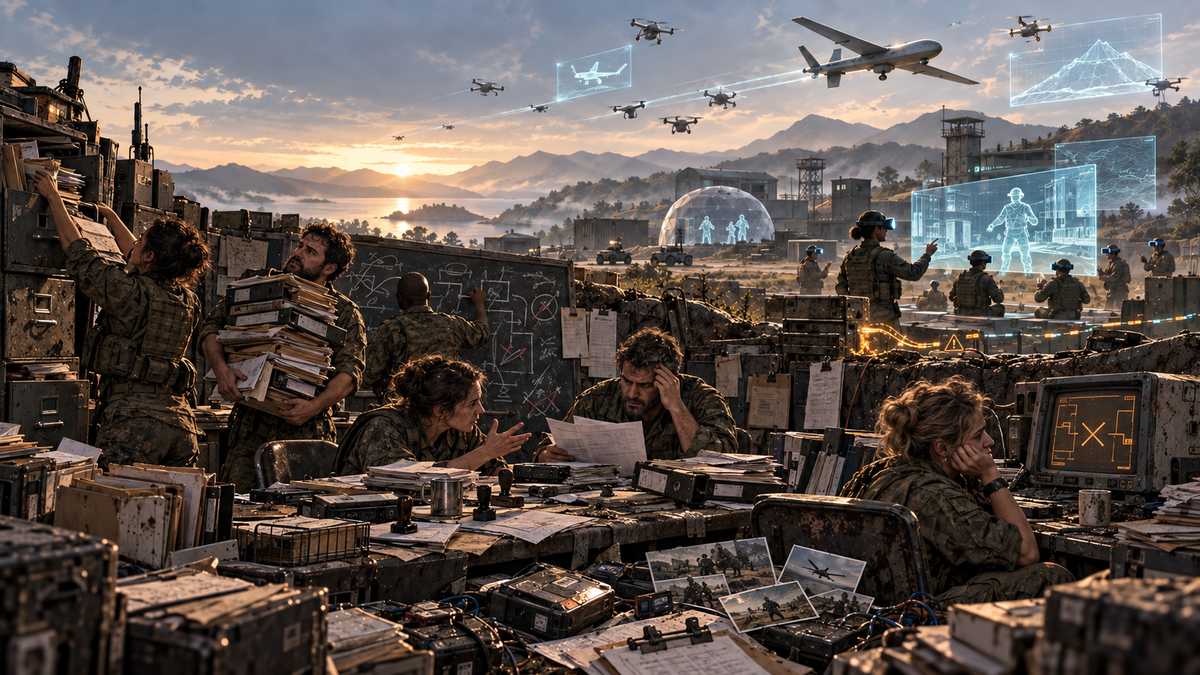
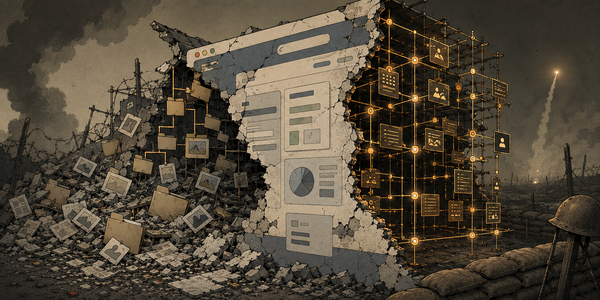
Australia and New Zealand have committed historic money to uncrewed systems, simulation and a far more digital battlespace. Every one of those capabilities produces rich media at industrial volume, and almost none of it is governed as an asset.
There are two ledgers in defence investment, and only one of them is being read closely at the moment.
The first is well covered. Australia’s 2026 National Defence Strategy and Integrated Investment Program commit around $425 billion in capability investment across the decade, with an additional $53 billion in new funding, on a trajectory the government puts at around 3% of GDP by the mid-2030s using its NATO-comparable methodology, or closer to 2.5% on the traditional appropriation measure. Among the program’s named priorities are expanding the adoption of autonomous and uncrewed systems across the land, air and maritime domains, fielding counter-drone capability to protect Australian sites and critical infrastructure, and long-range strike. Across the Tasman, New Zealand’s first Defence Capability Plan committed $12 billion over four years, $9 billion of it new, described as the largest planned uplift in a generation, with subsequent budgets adding maritime helicopters, new aircraft, digital communications for the Army, cyber capability, and the country’s first dedicated long-range strike and long-endurance ISR drone programs.
The second ledger is the one that determines whether any of it becomes capability: the system that turns a platform into people who can operate it. That ledger is in visibly worse shape, and both governments have said so in public.
What the same governments say about the training side
New Zealand’s position is the starkest, because it has been stated most plainly. Cabinet papers released this year describe much of the infrastructure used to train New Zealand personnel, classrooms and rifle ranges among it, as World War II era and increasingly ineffective. By the Force’s own accounting, a majority of the Army’s land training system had reached end of life by mid-2026, and land combat readiness had fallen to 45% at the end of 2025. The most recent budget funded training infrastructure to the point of design completion toward the end of the decade, not to rebuild. In the same period, the Chief of Defence Force said publicly that recruiting capacity needs to double, and that the Force needs the ability to scale two-fold, five-fold, ten-fold in a very short space of time.
Australia’s version is quieter but points the same way. ASPI’s 2026-27 defence budget brief puts precise numbers on the trade the budget makes: workforce funding up by $815 million, acquisition down by $724 million, sustainment down by $283 million, and whole-of-government defence spending falling in nominal terms by $799 million before back-loaded growth begins in 2027-28. Its assessment is that Defence is buying a future force by accepting that the present force will be able to do less today. Among the things it will do less of, ASPI lists training intensity, alongside thinner spare-parts holdings, reduced platform availability, less ammunition consumption and less time at sea, in the air and in the field.
Put the two ledgers side by side and the instruction is unmistakable. Generate more trained people, faster, across more new platform types, with less live training time and, in New Zealand’s case, with an estate that will not be rebuilt for years.
The synthetic side has to absorb the difference
There is only one place that slack can come from, and both forces already know it. Simulation, mixed reality, digital twins, mission rehearsal and drone-based training have stopped being a supplement to live training and become the mechanism by which a smaller, busier force generates readiness at all.
The direction of travel is easy to see. Counter-drone training is now delivered through mixed-reality systems with replica weaponry, running on synthetic environments that replicate real training facilities. FPV drone piloting is taught on software platforms proven in current conflicts. Maintenance training is moving to headset-based procedural rehearsal. Air training is experimenting with injecting virtual entities into the view of a student who is physically flying a real aircraft. Every one of these compresses time-to-competence, which is exactly what a force under a mobilisation instruction needs.
What nobody says about synthetic training
It is a content production system.
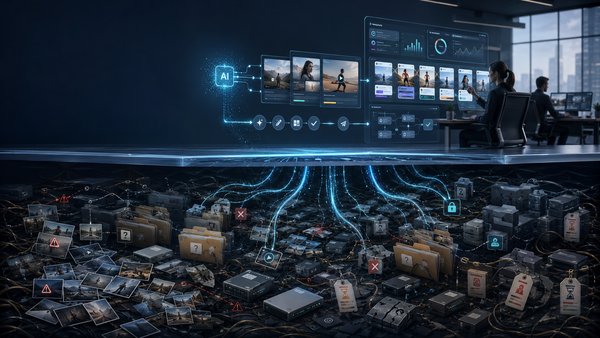
Every simulator hour, every drone sortie flown for training, every mission rehearsal and every counter-drone serial generates a substantial object set: session video, sensor feeds, telemetry, instructor-station logs, scenario configuration, after-action review material. A force that trains synthetically does not consume a library of content. It manufactures one, continuously, at a volume no document-era system was designed to absorb.
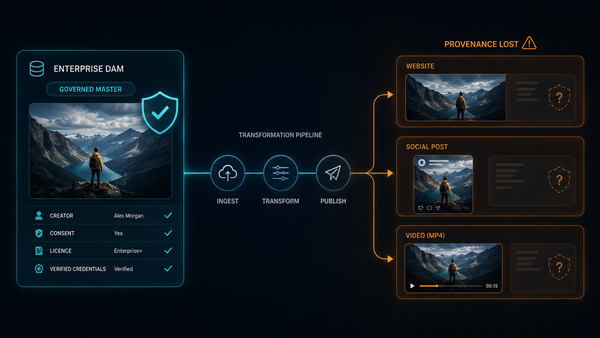
And these are not incidental by-products. They are the highest-value learning objects a training system produces anywhere: records of actual performance, in context, against a known scenario, generated by the people you are trying to qualify. In most environments they are also the least governed thing in the building. Reviewed once at the after-action review, then left on the simulator host or a local drive, with no classification handling, no retention decision, no version authority, no discoverability and no route back into the training environment that produced them.
The same is true of the operational content coming off new platforms. Sensor imagery, technical procedure, configuration data, capture from uncrewed systems. Each new type arrives on a shorter introduction timeline than a crewed platform ever did, and iterates faster once in service. The content types a folder-and-drive model handles least well are precisely the content types this decade of investment will generate most of.
Why this is a mobilisation problem, not an administrative one
Training throughput is not set by how many recruits present at the gate. It is set by how fast current, verified content can reach them.
That makes three things measurable, and all three are currently poor. Speed of update: the elapsed time between an equipment change or doctrine revision and the availability of correct content in the training environment, which in a manual model runs to weeks. Speed of absorption: the marginal effort to stand up a training pipeline for a new platform type, which today is close to linear with each introduction rather than drawing on established structure. Speed of scale: the ability to push training across services and dispersed locations, and to sustain it in degraded or disconnected conditions, which content held on individual drives simply cannot do.
Decentralisation sharpens all three. A posture built around dispersed small teams, northern and remote basing, and coalition operations requires content that can be served under authority to places with thin connectivity, by people who cannot ring the person who made it. That is a governance property of the content itself, not a property of the network.
The control problem that is arriving anyway
There is a second reason this stops being deferrable, and it has nothing to do with training throughput.
Content generated by and for new platforms arrives carrying handling conditions, set by the supplying nation, the manufacturer, or export control regimes on both sides of the Tasman. As technology-sharing relationships with allied partners deepen, the ability to demonstrate at the level of the individual object who accessed what, when, and under what authority stops being good practice and starts being the price of admission.
And the automation everyone is planning for makes it structural. An agent cannot hold a clearance. It cannot be briefed, vetted, or held individually accountable, and it will not exercise judgement about whether a file it found should have been in front of the person who asked for it. The only control that survives contact with automated retrieval is one where each object carries its own classification, access conditions and currency state as machine-evaluable policy. Every force in the region is planning AI-enabled training and decision support on the assumption that the underlying data is understood, governed and machine-readable. For the imagery, video and simulation output that will carry most of this decade’s new platform knowledge, that assumption does not currently hold.
The same failure, in a setting where it is not quarterly
This publication has spent most of its life on the commercial version of this argument, and it is worth naming the connection, because it is not a metaphor. It is the same structural failure.
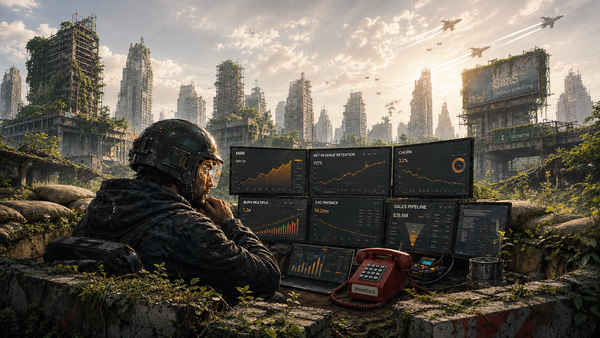
Over the past year investors have stopped valuing software on how sticky the interface is and started asking what exists underneath it. Is there something governed, structured and queryable that an agent could act on, or was the interface the entire product? The companies being marked down hardest are the ones where the interface was doing all the work, and where removing the human clicking through it leaves nothing for a machine to reason over.
Training content fails that test for exactly the same reason. For thirty years the interface was a person. An instructor knew which version of the procedure was current, knew which of the two similar files was the cleared one, knew that the visiting course should not be shown the sensor imagery, and knew it without a system telling them. That judgement was the control, and it was invisible precisely because it worked. It never needed to be written down, so it never was.
Strip that interface away and very little is left for a machine to act on safely. No reliable classification, no currency state, no authoritative record of what supersedes what, no schema an API can query with confidence. The commercial version of this failure costs a re-rating. The version described here costs a trainee taught from a superseded procedure, on a platform that has since been reconfigured, in a force that has just been told to double its throughput.
The blind spot, in its highest-stakes form
This is a familiar pattern in an unfamiliar setting. Logistics data is governed. Personnel data is governed. Maintenance and financial data are governed, and have been for decades, because everyone agreed long ago that they were data and assigned them an owner, a schema and a retention obligation.
The visual record was never given that status anywhere, in any sector. It has always been treated as the output of an activity rather than an asset in its own right, which is why it ends up governed by whoever last saved the file. In a commercial organisation, the rich media blind spot costs you a compliance exposure and a lot of duplicated work. In a force generating capability against a mobilisation instruction, it costs you time to capability, and it does so at precisely the moment the money has been committed on the assumption that the capability will arrive.
The questions worth putting on the table
Three would surface most of it, and none of them require a procurement to answer.
For a new platform type entering service, how long does it currently take between a configuration or doctrine change and the availability of verified, current training content to every location that needs it? If the answer is weeks, that is the ceiling on force generation, regardless of what the recruiting pipeline delivers.
Of the content produced by simulation and training activity in the last twelve months, what proportion is discoverable, classified, version-controlled and reusable today? For most organisations the honest answer is close to none, and the material is still sitting where it was made.
And when AI-enabled training and decision support arrive, which they will, what evidence would exist that an automated system retrieving training content had only surfaced material that was current, correctly classified and cleared for the person receiving it?
The platforms are funded. The people are being recruited against targets set at the top. What sits between the two is content, and it is the only part of the chain that nobody has a line item for.