Investors aren’t asking about retention metrics anymore.

They’re asking what happens if an agent can just... do it.
Every founder with a board has felt this shift in the last six months. The questions haven’t just gotten harder - they’ve changed shape entirely. It used to be: show me the retention curve, show me the expansion revenue, show me the logo growth. Increasingly, it’s a different question, asked more bluntly each time: what happens to this business if an agent can do the workflow directly?
You can watch the recalibration happen behind someone’s eyes in real time. The moment they stop pricing a product on stickiness and start pricing it on whether there’s a real asset under the interface, or the product is the interface.
This isn’t a hypothetical anxiety circulating in founder group chats - though it’s there too, and openly. It’s showing up in market pricing. Software stocks have taken their sharpest hits since the dot-com correction, on the specific fear that agents executing multi-step workflows directly will make per-seat licensing for a UI redundant. The operators saying it loudest aren’t disgruntled outsiders - they’re the CEOs of the companies whose growth depends on being right about it. One put it plainly: value now accrues to whoever holds the data, not whoever owns the workflow. Another, just as bluntly, called data the single most important moat left standing.
The pattern isn’t “SaaS is dead.” It’s more precise than that.
Total SaaS spend is still projected to grow substantially through the rest of the decade, so the apocalyptic framing overshoots the actual pattern. What’s really happening is a sorting exercise. Products with a genuine data asset or deep workflow lock are absorbing this moment as a headwind. Products that were never more than a well-designed layer over a model call, or over someone else’s data, are the ones getting re-priced - sometimes brutally, sometimes overnight.
It repeats category by category, and the logic is identical each time. A marketing platform that charges per seat for a UI to build campaigns starts looking exposed the moment an agent can update the campaign directly through an API. A project management tool that charges per seat for a board to track tasks starts looking exposed the moment an agent updates the underlying record without a human ever opening it. The interface stops being the moat the instant the primary user of the software stops being a person who needs one.
The audit worth running
So the useful question for a technical leader isn’t “do we have an AI strategy.” That question is comfortable enough to answer in a slide. The uncomfortable version is narrower: if you stripped the interface off this product tomorrow, is there something governed, structured, and queryable underneath that an agent could actually act on - or was the interface the whole product? Is there a moat?
Most organisations run that audit against their core systems of record and come away reasonably confident. Financial data, CRM records, HR systems — these have spent a decade being schematised, permissioned, and made machine-legible, because every enterprise architecture initiative of the last ten years assumed that was the substrate worth investing in.
Fewer organisations think to run the same audit against the content sitting just off to the side of that architecture: the images, video, audio and creative files that have quietly become one of the largest and fastest-growing categories of enterprise data - and one of the only categories that has never been asked to justify its own machine-readability, because nothing has ever needed to query it except a person clicking through a folder.
Rich media was always just a UI over a folder
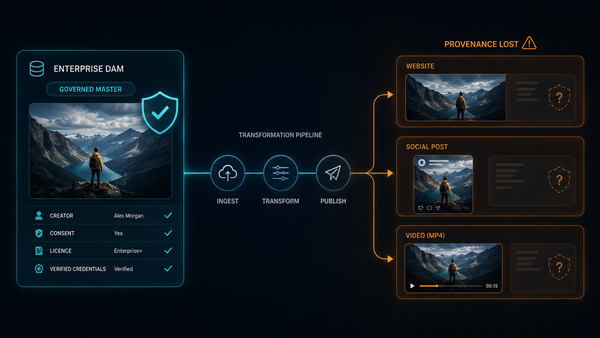
That’s the specific and uncomfortable version of this audit for anyone holding a meaningful rich media estate. It was never designed to be an asset an agent could reason over. It was designed to be browsed - search boxes, thumbnails, folder trees, a human deciding what looks right and dragging it into a document. The interface was never a convenience layer sitting on top of a governed data structure. For most organisations, it was the entire structure. Take the interface away and there’s very little left for a machine to act on safely: no reliable classification, no persistent rights or consent record, no schema an API could query with confidence.
That’s not a UI problem an agent can absorb the way it absorbs a clunky dashboard or a slow workflow. An agent working against rich media doesn’t just need the interface to disappear - it needs something legitimate to have existed underneath it in the first place: content that’s been enriched into structured, queryable metadata; governance that travels with the asset wherever it goes; a schema built for a machine to query, not a person to browse. Content, context, relevance, governance.
That’s a different build than a nicer library. It’s the difference between software that was priced on how it felt to use, and infrastructure that gets priced on what it actually knows.
The market is already sorting companies on this exact line. It’s worth finding out, before someone else does it for you, which side of it your rich media estate is actually on.